
Clark County Police Blotter Status
Clark County publishes no 72-hour, weekly, or rolling arrest log. The official sheriff site lists none. Dubois and Spencer post no police bulletins either. The Clark County Jail has no public web page of its own. The Idaho Sheriffs' Association directory shows that gap. Any search page displaying neat rows of current bookings would be inventing a service. The county does not offer it.
A multi-day picture still exists, just in pieces. The sheriff holds the booking record. The county processes public-record requests, and Idaho iCourt tracks later case events. Regional news covers selected incidents when editors choose to. None of these sources alone forms a complete chronological list.
Read Clark County Arrest Records
Start from the date and the agency, not an unofficial list. A Clark County arrest can end up booked in Dubois, another Idaho county, Montana, or a federal facility. Whichever office did the booking holds the record.
- Identify the incident date, location, person's name, and likely arresting agency.
- Ask Clark County Jail at 208-374-5403 about the correct custodian and present custody.
- Submit the county public-record request form for the booking sheet or incident record and state a clear date range.
- Search Idaho iCourt by party or case when a later filing should exist.
- Check dated regional reports only for context, then verify their claims with sheriff and court records.
Think the arrest happened today? The Arrests Last 24 Hours page is the tighter route. It covers the lag between a fresh arrest and booking approval. That lag also applies to VINE updates or a court filing. A multi-day search works differently. It moves backward through official custody and case sources while keeping every date intact.
Clark County Blotter Fields
Clark County posts no log result online. These fields are what to request and verify instead. Availability turns on what record the office maintains and what the law lets it redact, not on any promise of a posted table.
| Requested field | Reading rule |
|---|---|
| Name and booking identifier | Match the jail event; do not confuse it with a case or IDOC number. |
| Arrest and booking date | Keep these separate because transport and intake take time. |
| Arresting agency and location | These determine who created the report and where booking occurred. |
| Booked charges | Treat them as charges, not final court findings. |
| Bond, hold, release, or transfer | These may explain custody changes across the window. |
| Case number and court date | Verify later events in the court record. |
| Booking image | No county online display policy was verified; ask whether an image exists and is releasable. |
A booking entry answers one question. A court record answers another. Charges can be reduced, amended, declined, or dropped as a Clark County case moves forward.
Clark County Weekend Record Gaps
No archive depth, roll-off rule, weekend queue, or holiday posting practice is public. The common assumptions fall apart. There is no guaranteed Monday dump. There is no tidy seven-day window. Physical arrest, booking, records review, VINE transfer, news release, and court filing can each land on its own schedule.
Call the jail for present custody. Use the county form for the record itself. The county promises contact within three working days, not production by then, and exemptions or clarification requests can stretch the timeline. The courthouse number, 208-374-5402, handles court matters only. Treat it as the wrong line for booking questions.
- Booking
- Jail intake following arrest.
- Blotter
- A chronological agency publication; Clark County has no verified public one.
- Disposition
- The later court result, not the charge entered at booking.
- Detainer
- A hold from another authority that can affect release.
The countywide Clark County recent-arrest hub splits the channels apart: jail, court, state correctional, federal, and immigration. That split matters once someone leaves Clark County Jail. Release, transfer, and sentencing are different custody states, not data that went missing.
Clark County Arrest Archives
No web log has a known cutoff. Ask the sheriff or the county records custodian first about an older booking. The file may sit in agency custody. It may have been transferred, or destroyed under a retention schedule. Idaho Code section 31-871 sorts county records into classes. It sets minimum periods by class. Those rules still prove nothing about whether any particular booking photo or sheet survives.
The Idaho State Archives holds state, county, city, sheriff, court, and newspaper material of long-term value. The Archives also keeps Idaho newspaper microfilm and offers a research request path. No Clark-specific booking-photo series is cataloged there. Contact the county first. Ask the Archives about a Clark County collection only after custody or transfer is clear.
Media recordings follow their own retention rules. Idaho law sets separate minimums for certain law-enforcement recordings, including events around an arrest. Those periods do not attach to every jail image. Ask for the applicable schedule and any litigation hold. Also request the destruction status of the exact record you want.
Note: A dead news page does not prove an official record was destroyed, and a surviving unofficial copy does not prove current custody.
Clark County Arrest News Pattern
News outlets cover Clark County only occasionally. East Idaho News and the Local News 8 Crime Tracker have both touched on incidents in or near Dubois. One 2021 story described a transport to Clark County Jail. Charges had not reached the public court search yet. That gap is booking-to-court lag, not a standing blotter.
A 2023 report opened with a chase inside Clark County. The arrest itself happened in Montana. An older Idaho State Police impact report described a traffic stop near Dubois and booking into Clark County Jail. Incident location, arresting agency, booking jail, and court jurisdiction are four separate fields. Keep them apart when you read.
Regional news is a secondary source. Coverage is selective, and publication dates rarely match the actual arrest or booking time. Confirm any article with the sheriff and the court before relying on it.
Commercial mugshot sites fare no better. Mugshots.com lists an Idaho index with a Clark County section, while RecentlyBooked, Arrests.org, Busted Newspaper, and Mugshots.zone carry no Clark-local page. Stale listings are common on those platforms. Official records come first, and no names or faces are reproduced here.
Clark County Court Follow-Through
Booking is only the first step. Idaho's iCourt portal picks up the matter once a public case has been filed. Search by party, county, and case. Expect a possible lag between the jail event and the court entry. Sealed and juvenile matters may not appear publicly. The official iCourt search screen shows why a later court check belongs beside a police blotter, never inside it.
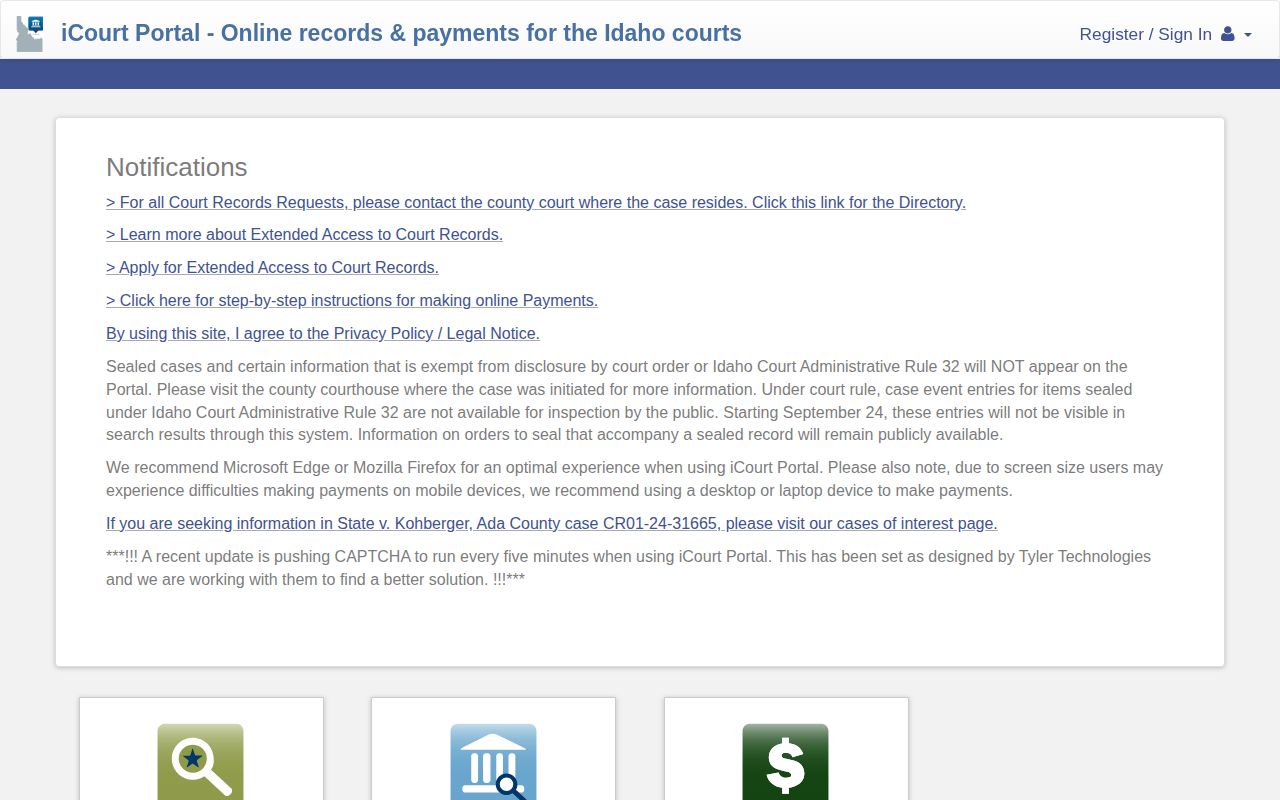
The court portal can establish filed case events and disposition. It does not report live jail custody or turn one news story into a full county arrest log.
Request Older Clark Arrest Records
A records request works better when it is specific. Name the person if known. Give a tight date range and the likely agency. Say exactly what you want, whether a booking sheet, incident report, image, release entry, or court file. Broad wording slows the custodian down. The county form includes delivery and fee fields, so ask for a cost estimate before work begins on a large request.
Keep the agencies straight. The Clark County Sheriff's Office runs the jail and answers law-enforcement questions. The county clerk handles public-record routing. The courthouse holds the court file. Idaho State Archives is a later historical route, not a substitute for asking the county where the record sits. If a file was transferred, request the collection name and transfer details.
Some records are lawfully withheld or redacted. Juvenile material, sealed cases, and private information may stay out of view. A proper denial should state its basis and your response options under Idaho public-records law. Never plug a gap with an unofficial profile.
Dates tell the real story. The arrest date, booking date, article publication date, request response date, court filing date, and disposition date can all differ. Log each one as you go. That timeline explains most apparent conflicts and keeps an old arrest record from being misread.
Public Record Search
Sponsored Results